Donna and Joe have finished their assignment in India. Occasionally they still travel somewhere.

Showing posts with label how it's done. Show all posts

Saturday, April 11, 2009

Camel Safari

Planes, trains and automobiles are all more comfortable ways to travel around India than riding a camel. But then we didn’t ride the camels to get anywhere; just for the experience. For the record Donna says she was pretty comfortable sitting on the camel. My first problem was that the stirrups were too narrow for my shoes. When I got my shoes stuffed into the stirrups they pinched my feet. After I took my shoes off my feet were more comfortable but I still felt squeezed between the saddle in the back and the camel’s hump in the front. All the time we rode them the camels were walking with a gait and a feel very much like a horse, except that a camel has a much longer stride and takes fewer steps per minute.

Camels kneel down to let a person get on their back, then stand up. In fact it has callused pads on its knees and its chest where it rests on the ground. Here is Donna's camel getting up with Donna on it's back. We were the only paying guests on the safari, which also included 4 crew members and 3 camels. Donna & I each rode a camel and each of these camels had a handler. Most of the time the handler rode on the camel cart and loosely held the camel’s reins. The camels knew the program and mostly followed the cart anyway. Also riding on the cart was the driver and the guide. The cart carried a tent, folding table, cook stoves, gas cylinder, food, bedding, etc. So the one camel pulling that had a much harder job than the two we were riding. Donna asked if they switched the camels around but apparently the camels are specialists. The camels and their handlers are also paired long term, just like elephants and their mahouts.

We met our camels and crew in small village south of Bikaner. This is the view as we head out from the village on the road to the desert. We were there in the dry season and the land was mostly empty of people. Later in the year , during the monsoons, people will return to the empty huts to raise muskmelons and other crops.

Here's a view of the land a little further out. Out here there really isn't a road, although in places you could see we were following a track where other camel carts had gone before us. We rode for a couple of hours then stopped for some lunch at a spot where several small trees offered some shade. A camel travels about 6 km/hr so by then we were out of sight of any signs of civilization. They unsaddled the camels who immediately rolled in the sand.


The crew brought along two gas cook stoves. They made chapatis (flat bread) on one and heated rice and vegetables in sauce on the other. They also sliced some fresh vegetables and had a variety of cold drinks in a cooler. It was hot in the mid-day sun so we all took a break after lunch.

While we were resting we couple of shepherds came through driving a herd of sheep and goats.
Here you can see the white sheep and black goats spread out over the land eating whatever green they can find. If you click on the picture to enlarge it you see that the dot in the upper right is one of the shepherds. As they went by we noticed that the second shepherd was carrying a tool with looked like a small hatchet with a four foot handle. Later in the afternoon we passed him standing in a tree using that tool to chop the high branches out of the tree. He was throwing them to the ground where some of his flock was happily eating the leaves.

In the middle of the afternoon we started off again and traveled another couple of hours to a campsite where there was a concrete building and a couple of huts built of sticks and thatched with straw. The concrete building was used to store equipment like a dining table. The huts seemed to be of use only to the birds who had built nests inside and liked to sit up on the roof.

The camel handlers rode home on the two camels we had ridden, leaving the third camel to bring the remaining four people and all the gear back in the camel cart. Here he is eating his dinner. I have boosted the contrast a little so you can see the patterns cut into his fur. These serve as identifying marks so the owner can always identify him.

Donna and I went over a small rise to watch the sunset over the desert. When we came back these two musicians were waiting for us.


The one on the left played the double flute on some songs and the harmonium on others. He plays the melody on the right hand flute by covering and uncovering various holes. On the other flute he plays a single note. The box in front of him is a harmonium which is not an instrument native to India but is now widely used, especially in north India. It is similar to an accordion with a keyboard and a bellows to pump air through reeds to make the sound. The bellow comprises the whole side facing away from him, which hinges at the bottom. While playing he used his right hand to work the bellows and his left hand to play the keyboard.

Although you cannot see anything on this video you can hear what they sounded like. After the concert the musicians walked off into the darkness so civilization can't have been too far away. But is was far enough away you could not see any buildings or road. You could not hear it either although after it was dark you could see the glow of lights over the horizon.
The crew pitched a white, 2-person tent for us and put a thick pad on the floor of the tent for us to sleep on. I slept pretty well but Donna found that the noise of the wind flapping the tent kept her awake. She considered moving outside but noticed that the crew was also sleeping up off the ground and decided that might be necessary to avoid unwanted critters sharing your bed.
In the morning we headed back to village where we started.

I actually took this picture of a youth heading out into the desert with his camel cart the previous morning. But it seems a fitting way to end this post. A reminder that there are still many different people in this world and for some the rhythm of daily life is very different from that of an urban office worker like me.

Friday, March 27, 2009

16th Century Astronomy & Astrology

Jantar Mantar means “Instrument for Calculation”. Jai Singh, founder of Jaipur built five sites, each with multiple instruments for astronomical observation. We visited the one in Jaipur which is quite well perversed including the world’s largest sundial, shown here. The edge of the inclined ramp casts a shadow either to the east or the west depending on the time of day. The slope is carefully constructed to be parallel to the earth’s axis of rotation. Jaipur is at 27 degrees north latitude so the angle to the ground is also 27 degrees.


The basic principle of operation is more easily seen in the second picture of the “small” (prototype sundial which was built first and) which is 1/10 the size of the big one. The shadow of the long ramp falls on the inside of the cylindrical dial (being examined by the tourists in the second picture). The cylinder is split in two and spread apart so that each edge of the ramp is exactly at the center of the corresponding quarter cylinder. The cylinder of the large sundial has marks representing 2 second time intervals. The graduations are carved in white marble and so are still quite sharp. The smaller sundial is only marked with 20 second time intervals. It was overcast and drizzling when we visited so we could not see the operation of the sundial. The sun subtends an angle of about half a degree which corresponds to about 2 minutes of time at the earth rate of rotation. So it seems that it would be difficult to read the sundial to even 20 seconds of resolution, let alone 2 seconds.


There is a second instrument near the "small" sundial which consists of two flat, circular surfaces perpendicular to the earth’s axis, one facing north, the other south. By observing which face is illuminated by the sun you can tell whether the sun is north or south of the equator. There is a post in the center of each face and marks by which you can also tell the time, albeit much less precisely than with the large sundials.

This instrument is designed to measure the position in the sky of the sun at anytime of the day. It consists of small hole in a disk suspended by wires over a hemispherical dish. This picture shows only half of the instrument. The other half, which is located nearby, completes the hemisphere because sections which are missing in this part are present in that one and vice-aversa. The reason strips are missing is to allow an observer to get close enough to the inside surface of the hemisphere to read the location of the spot at the center of the disk. The sundials also have marks on the edges of the ramps so an observer could in principle make the measurement of the sun’s declination using those marks. But this instrument is marked with two sets of spherical coordinates, one centered about the vertical and another centered a line parallel to the earth’s polar axis, eliminating tedious calculations. When discussing this instrument, the guide explained that Indian astrology is much more precise than western astronomy. This is because it accounts for not only your zodiac sign but position in the sky of the sun at the time of your birth.

There is a second two part instrument which appears to allow the same measurements. Is consists of two large, vertical cylinders with poles in the center. The walls and floor of the cylinders is marked with radial divisions and vertical divisions so the altitude and azimuth of the sun can be read from it’s shadow.


There is also an instrument dedicated to observations related each zodiacal constellation. They appear to be similar to the large sundials and each has a ramp with a different slope and is pointed in a different azimuthal direction. The guide explained that each points at a different elevation because of the different positions of the zodiacal constellations relative to the equator. However she did not know why they are aligned in different azimuthal directions or exactly how they were used.

Tuesday, February 3, 2009

Plane Tickets

I bought plane tickets online for a trip to see Ellora caves and attend the wedding of one of the IBM compact modelers. I thought pricing of tickets was worth a brief blog post. The screen shots below show two options for traveling from Indore to Bangalore via Mumbai. The first one offers a fare of 51 rupees (about $1) +tax per person. Even after you add the tax I would expect that to be cheaper than 2024 rupees +tax /person. However, when you click on the "Fare Summary" pop-up you see that the 51 rupee fare is 9500 rupees total for 2 people, while the 2024 fare is only 9466 rupees for two. (9500 rupees is about 200 dollars) I know that these prices typically include both a fuel surcharge, collected by the airline, and tax collected by the government. I have no idea how these amounts are calculated.


These screen captures are much clearer if you click on them to see the version with less compression applied.

Friday, November 21, 2008

Train Tickets in India

Donna and I have taken trains trips twice before in India. In each case someone else bought the tickets for us. On our last trip, which was partly by train and partly by plane, I used the IRCTC (India Railway Catering and Tourism Corporation) online reservation system. Although I read the online tutorial, this still required searching the internet for answers to questions like "What does 'RAC 4' mean?". I found all the information I needed on a helpful discussion group about India.
The website asks for where you're leaving from and where you're going to, what date and what class of ticket. There are eight classes of ticket, although not every train has cars of all eight classes. There is first class AC (air conditioned). In the movie "The Darjeeling Limit" the brothers traveled first class(AC). There is also first class--which is not air conditioned, but this is disappearing. There is AC 2 tier and an AC 3 tier. We have described these in an earlier post. Sleeper class cars have the same layout as AC 3 tier, but no AC. Also the railroad doesn't provide any bedding, so you need to carry your own. There are also AC chair cars, which is what Donna and I took from Chennai to Vijayawada, a trip of about 450 km which took about 6.5 hours. The cars have rows of seats, two abreast on one side of the aisle and three on the other side. Seats are similar in size to coach class airline seats, but are spaced to give a little more leg room than that. They have a rack for luggage above the seats on either side. On some trains there is an executive chair class and finally, there is 2nd class sitting class.

After answering all the questions, the system will find all the trains on your route, on that day, with that class of car. You can select one and pull up the availabilty of that class ticket for the selected day and the next 6 days. It will have indications like "WL 7 / WL 2". There is a key at the bottom of the pop-up which tells you that WL=wait list and RAC=reservation against cancellation. So WL 7 means that there are 6 people on the wait list and you can buy a ticket and be number 7 on the wait list.

It doesn't explain why there are two designations for every train. It turns out the the first one is a running count ignoring any cancellations which have already occurred. Once you buy a ticket you will be WL 7 on that train and that number doesn't change. The second number accounts for any cancellation which have happened. Once you buy a ticket you can track your progress on the wait list (using the website or by phone). Hopefully it will go from "WL 7/ WL 2" to "WL 7/ WL 1" to "WL 7/ RAC 4" ... to "CNF". CNF means confirmed--you will get a set or a berth on a sleeper.

So what is RAC 4. "Reservation Against Cancellation" means you can get on the train, but you and someone else have both been assigned the same berth. So you can both sit on it but you can't lay down on it and sleep.

By the time I went to buy tickets (about a week before departure) there were no tickets with status "available" in any class on any of the trains from Bangalore to Chennai. So I actually bought two tickets. One in Sleeper Class with status "WL 2 / RAC 3" which meant I would definitely be able to get to Chennai. This ticket, for the 200 km trip, cost 176 rupees (about 4 dollars). You can cancel tickets up to 24 hours before the train starts its run with no charge. When I canceled the day of the trip I got 126 rupees refund. I also bought a ticket in AC2 (air conditioned with bunks stacked 2 high.) This level of luxury cost me 676 rupees (~$15) My ticket was "WL 7/ WL 3" which my friends assured me that it would be confirmed by train time and it did but not until the day of travel. My sleeper ticket became confirmed a day after I bought it.

My train started its run in Mysore and was schedule to stop at my station just before midnight. It was a little late so I had time to wander around the platform and snap these pictures.
My cell phone camera does not have a flash so the pictures are not that good. The first one is a close-up of the print-outs on a bulletin board. The second contains the names and car/seat assignments of everyone on the wait list/RAC list. They are arranged in order of the first number in our status when you first bought the ticket. I got to the station knowing my seat assignment because I checked the website before coming to the station. Otherwise you can find your seat using these boards.

The second picture shows the board which shows the order of the cars in the train. For example, I was in car A2, which was in position 9 (counting from the engine). These positions are marked on the platform and the train stops aligned to these marks, so you can wait for the train at the point where your car will stop.

Thursday, October 23, 2008

Cement

I stopped on my way to work and snapped this picture. If I had had more time I could have eventually gotten the picture I was trying to take of the human chain passing pans of concrete up to the second floor of the building. (Actually in India the ground floor is zero and the first floor is the one above that so this is the first floor.) The guy in orange appeared to be the foreman and he definitely thought he should be in the picture. So did the young boy holding a carrying pan.

Behind them you can see the man in the white sleeveless shirt shoveling cement into a pan. He is using the standard India shovel which has a handle about two feet long set at an angle of about 150 degrees to the blade. Meaning the handle is folded back over the top of the blade. It positions the handle well for lifting and carry with the shovel but means you must bend way over to dig in the ground.
When he has a pan full the man with the red head scarf will lift it, pass it to the man in the black shirt, who passes it to the man in the white cap, who passes it to the man in the striped shirt. They execute this so quickly and smoothly that the pan flies up to the next floor in one smooth movement taking less than a second.


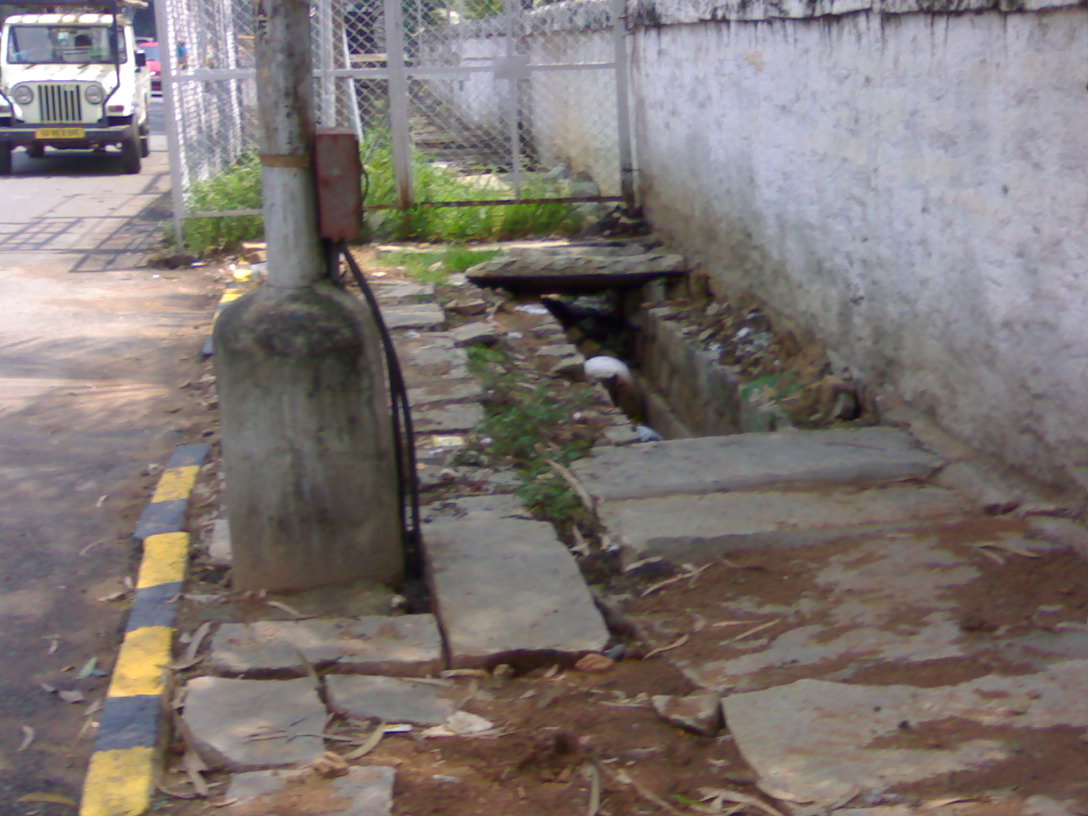
The next two pictures where taken at a different place and time. These people are casting concrete slabs which will become a sidewalk. Sidewalks are not cast in place because the storm sewer runs under the sidewalk. The slabs have two holes in them to use when lifting them on and off of the sewer.

These three kids were in charge of loading the cement mixer with sand, gravel, cement and water. Each of these they carried on their heads from the staging area to the machine. Young kids can be seen at working at construction sites all over Bangalore.


From Donna:

People who make cement sidewalk panels should have plenty of work available.
Between the roads being widened and the fact that sewers on the sides of the road under the sidewalk are usually just unstructured ditches, they are constantly in the need of repair. Walking is treacherous and one always has to look where you're stepping.


Since my feet have a tendency to roll to one side, I was tripping a lot. After learning that Luna could get sick if she even picked up a bit of poisoned or rabid animal dropped by a crow, I was watching her like a hawk, and had an even harder time watching where I was going.

I took to walking everywhere with a long walking stick, so that I didn't end up falling in front of traffic. Soon some of the kids at the apartment complex proudly presented me with an even better stick. And some apartment complex guards that I visited with on my walks with Luna found the "mother" of all walking sticks, a big piece of bamboo pole that was painted on one end.

It became my trademark, and was known around the complex as my "Moses stick". I met people who thought I used it to control my dog, since big dogs here are usually aggressive, untrained guard dogs. Some people thought I used it for self-defense, in some sort of martial arts.

One day I stopped at a small grocery, and someone asked me about my stick. I explained why I used it, and they told me that they were part of an organization that helped provide mobility aids to those who were disabled. I commended them on their work, and was happy to hear such an organization existed. After some more conversation I realized that they wanted to know if I wanted a cane! Besides being quite happy with my walking stick, I figured that the persona of someone who could defend themselves, or who had a dangerous dog was probably much safer from attack than someone who looked frail enough to need a cane. (Especially since I have been known to walk my dog on the street outside the apartment complex at 1 a.m.!)

Wednesday, July 30, 2008

Blacksmiths at work

These guys are cutting steel bars into small pieces to make grills to cover windows. The pieces will be welded together next. They are on the side walk in front of their shop. There was an older man, possibly their boss standing around and scowling at them. I asked if I could take their picture and he grunted and scowled at me, but they were happy to have their picture taken and pose for me any way I wanted.

The bars they are cutting are about a centimeter square in cross section and they mostly cut them with a single blow. One holds the piece to be cut on an anvil with a pair of pliers. With his other hand he holds a wedge against the piece to be cut. The wedge has a loosely connected handle to isolate his hand from the vibration of the blow. The other smashes the wedge with a hammer severing the bar.

I did not see any kind of a measurement instrument. They were cutting quite a few short pieces completely by the calibrated eyeball method...no measuring of one against the previous one, just line up the wedge by eye and whack it. Maybe the boss is scowling because he knows most of the pieces will be the wrong length.

Monday, June 30, 2008

Breaking Rocks

Unfortunately I did not include anything in the foreground of this picture to calibrate the size. The thin slabs of stone are about 8-10 cm (3-4 inches) thick. They were delivered as large blocks like those directly behind--about 80-100cm(30-40in) square by 2-3 m (6-8ft) long. Has near as I can tell they are being cut in to these peices by men using a hammer and chisel.